By Sarah Marin
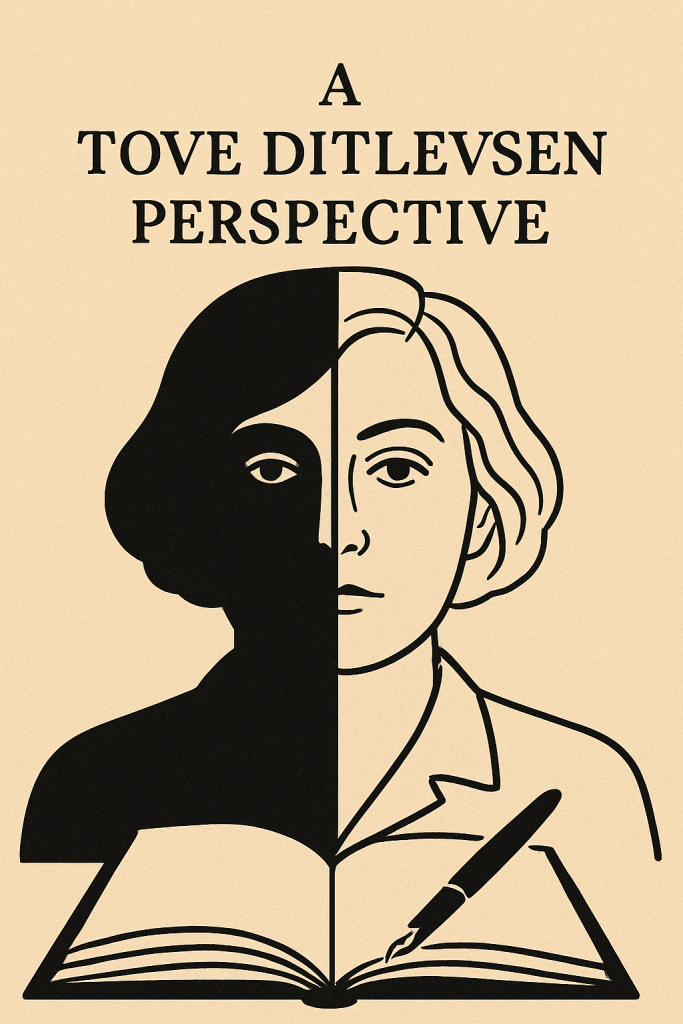
My genre of choice for reading is nonfiction, memoirs, to be more specific. I enjoy reading about real life, particularly the human experience. There are very few writers who can intrigue me to the point where I cannot put a book down. I won’t list them all here—that will be saved for future writer showcases.
Today, I want to talk about Tove Ditlevsen. Her story entered my life in a mysterious way; I simply cannot recall how I found her, that kind of mysterious. The first book I ordered was The Copenhagen Trilogy. I was captivated by her use of language, the way her sentences flowed, and how her mind shaped her words. I felt as though I were reading someone I understood from within—someone who got it, like me.
The Copenhagen Trilogy is divided into three parts: Childhood, Youth, and Dependency. In each section, Tove Ditlevsen shares her life story in a profoundly intimate and detailed manner. I have always admired individuals who can remember such intricate aspects of their past, I unfortunately lack this ability. Within each part, I feel a connection to how she was raised, how she experiences emotions, and how she ultimately chooses to live.
From the very beginning, love appears to be an uncertain and fragile matter for her. The one person from whom she most desired affection—her mother—was emotionally complicated. As Ditlevsen recalls, “My relationship with her is close, painful, and shaky, and I always have to keep searching for a sign of love.” For anyone who has experienced a similar maternal relationship, the depth of that search and the desperation that comes with it as a child is deeply relatable.
Tove Ditlevsen was a woman who seemed to feel emotions without outwardly expressing them, in a sense. She was quiet and kept her innermost thoughts silent, yet she could fully express herself through her writing. I, too, find that I can express myself more clearly through words on paper than I can by speaking them aloud. Then again, many people are this way, writers in particular.
It is Tove Ditlevsen’s writing, her ability to express herself through language, that makes her so deeply relatable. One cannot help but wonder what might have happened if she had listened to her father’s discouraging words: “Don’t be a fool! A girl can’t be a poet.” Ditlevsen’s form of self-expression, her sanctuary, might have been lost—submerged in a sea of despair.
She was a delicate woman, yet one who could hold her own. One of the things that captivated me about her was that she seemed to struggle with love. Her life moved through multiple relationships, ebbing and flowing with her growth as a person and ultimately, her growth as a lover. This is where she intrigues me: her personal life, particularly her relationships.
Just because someone has multiple marriages doesn’t necessarily mean they struggle with love. They’re struggling with something, certainly, but what is it about the love part? When I read about her childhood, I saw that she came from a loving family, yet one that did not express that love overtly. There was no warmth in the form of hugs or verbal affirmations from her parents. I could relate to this understanding of who she became as an adult woman. I was raised in a similar environment, a household that was loving and supportive, but not expressive in the ways love is often shown. I did not have multiple marriages or relationships, far from it. I kept myself at a distance from love; I wasn’t interested in it, or perhaps I simply couldn’t understand it.
So, as I read about her life and dove deeper into who she was, how she loved, or didn’t, I began to wonder if this played a role in her struggles with addiction. The question began to form: Does love truly play that deep of a role in a person’s experience? Can love save us from ourselves, from falling into addiction, from trying to numb the void we can’t explain, or from soothing the pain of a life fractured by early emotional neglect or abuse? Can the absence of love at the beginning of our existence shape the way we suffer later on?
Psychologists and trauma theorists would argue yes. Addiction is often described not simply as a disease of the body but as a disorder of attachment, a way of filling the emptiness left behind when early bonds are broken or never securely formed. In this sense, substances become substitutes for care, intimacy, or security—what the child never received in abundance, the adult seeks endlessly in altered states. When I consider Ditlevsen’s relentless search for both recognition and escape, I can’t help but see the shadow of this early absence. Her work itself seems to circle back again and again to the wound of not being fully seen, fully loved, in childhood. And it raises the unsettling possibility that addiction is not only about the lure of a substance but about the desperate attempt to soothe the unspeakable ache of unloved or troubled beginnings.
So this is where I find myself, thinking about Tove, the woman she was, the depth she carried. She is the kind of woman I would love to sit with, to talk, to share a coffee, to smoke a cigarette with. Her words, her complexity, her humanity captivated me. She stays with me—the kind of writer who can do that through her language and lived experience.
That’s what sharing the human experience is about: finding that person, that writer, who catches you and makes you pause—makes you think.
 Le Commune Review
Leave a comment