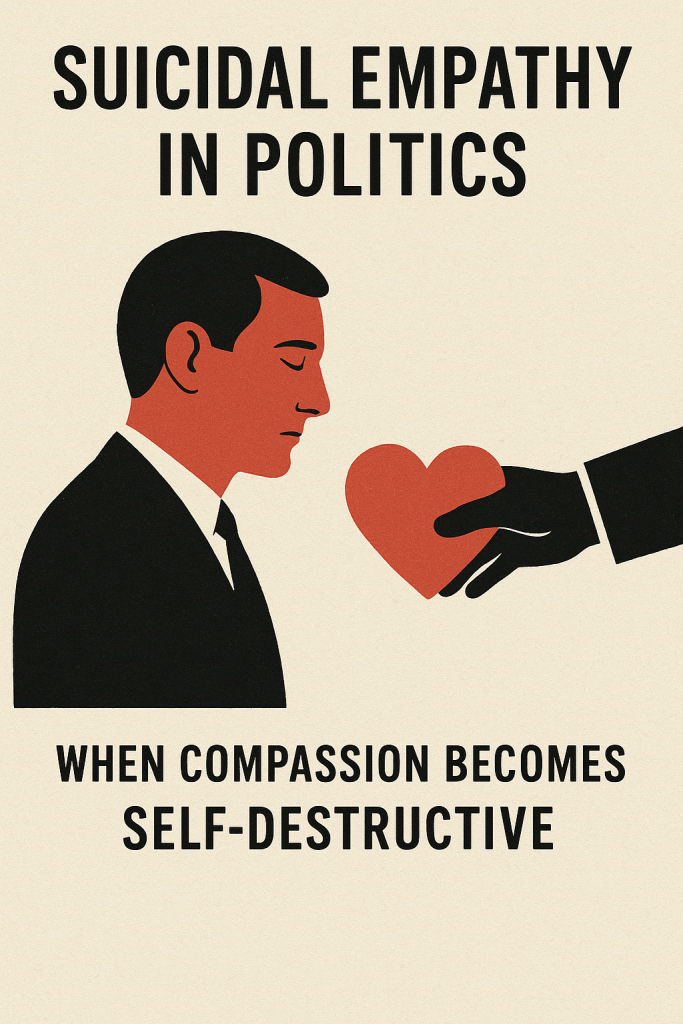
I had an understanding of what suicidal empathy was long before I encountered Gad Saad’s work. I recognized that some of my actions were self-destructive, but I didn’t have a term to describe them. Throughout my adult life, I repeatedly excused harmful behavior directed at me and allowed it to continue, often without fully realizing the emotional damage it caused. I invested emotionally in individuals who consistently re-entered my life, often at the expense of my own mental and emotional health. It took years for me to recognize the consequences of this pattern and for suicidal empathy to manifest fully in my life. Now, I am working to recover from these self-destructive tendencies, and I have developed a form of empathy burnout due to the repeated experiences of prioritizing others at my own expense.
Now, how does this tie into politics, and does Gad Saad have a point with the political climate we are seeing? Just like in personal relationships, suicidal empathy can show up in society and politics when people continue to care for or accommodate others, even when it’s clearly harmful. Citizens, leaders, or institutions may excuse destructive policies or behaviors out of a desire to appear compassionate, fair, or morally correct. This kind of overextended empathy can allow harmful actions to persist, sometimes at the expense of social stability or collective well-being. Saad (2019) emphasizes that while empathy is valuable, without boundaries it can become self-destructive on both personal and societal levels.
What exactly does suicidal empathy mean when applied in a political sense? Has this been occurring for generations, or is it a sign of the times, the latest trend, so to speak? When you look at history, suicidal empathy has occurred for generations, long before there was a name for it. Today, we have a modern term to describe an empathic response that, while initially adaptive, can ultimately become maladaptive. Saad (2019) points out that what begins as an adaptive empathic response can become maladaptive when extended too far, resulting in self-destructive outcomes.
Once the consequences of maladaptive empathy become clear, it can be too late, or it may take years to repair the damage. In a political context, this can occur when voters, blinded by anger at the current political climate, prioritize idealism or moral fairness to such an extent that they elect leaders or support policies that ultimately harm society. Acting out of a form of anti-government thinking, they may believe they are serving the greater good, even in spite of clear evidence that their choices destabilize institutions and put communities at risk. In this way, voters engage in self-destructive empathy, placing their own security and well-being in jeopardy while thinking they are acting with compassion or moral principle. Yet, they remain largely clueless of the consequences of their actions, blinded by rage and an entitled sense of oppression.
Why does wanting to protect your country have to be labeled as racist, radical conservative, or even fascist? Why can’t it simply be recognized as an effort to safeguard a society and nation that millions seek out each year for its promise of opportunity, safety, and stability? No government is perfect, and history shows that too much government can be harmful. What many seem to overlook is how fortunate they are to live in a society where they can freely express their views, display any flag, and speak their minds. Yet, in exercising these freedoms, some act as if their perspective is the only valid one, dismissing all opposing opinions.
We are inundated with propaganda on every news outlet and social media platform, and algorithms reinforce the views and ideas we already hold. It can be difficult to see the true state of society’s well-being when all sides are in constant opposition. Yet one common thread seems clear: everyone wants to be heard, to be seen, and to believe that their own views, or those of their in-groups, are correct. If we do not move beyond this cycle of propaganda, what will become of those who voted out of suicidal empathy, and what will become of the nation?
Just as it took me years to recognize the consequences of my own self-destructive patterns and the ways I allowed others to harm me, it may take this country years to fully grasp the effects of collective suicidal empathy. Awareness is the first step, both personally and politically. Only by recognizing these patterns can we begin to set boundaries, make thoughtful choices, and prevent further harm. My experience shows that clarity often comes slowly, but it is necessary for growth, healing, and the survival of both the self and the society we hope to protect.
 Le Commune Review
Leave a comment